
Feature
In Africa’s dynamic entrepreneurship landscape, the conversation around access to finance for women-led enterprises has never been more critical. At the Lionesses of Africa Start-Up Night Africa 2025 in The Hague, leading women entrepreneurs and investors came together to explore how capital, when thoughtfully structured, can unlock exponential growth. The event, supported by the Ministry of Foreign Affairs of the Kingdom of the Netherlands, showcased real-world success stories of African women founders scaling beyond borders and redefining the continent’s investment narrative.
Two standout voices from this year’s panel discussion at the event, Yvette Tetteh of Pure & Just Co. (Ghana) and Hadija Jabiri of GBRI (Eat Fresh) (Tanzania), offered compelling proof of what happens when investment meets ambition. Their experiences demonstrate that women entrepreneurs are not only growth drivers but also powerful ecosystem multipliers — creating jobs, building export industries, and delivering consistent returns. This feature story captures their journeys and calls on investors, policymakers, and partners to take Africa’s women-led enterprises seriously as engines of sustainable economic transformation.
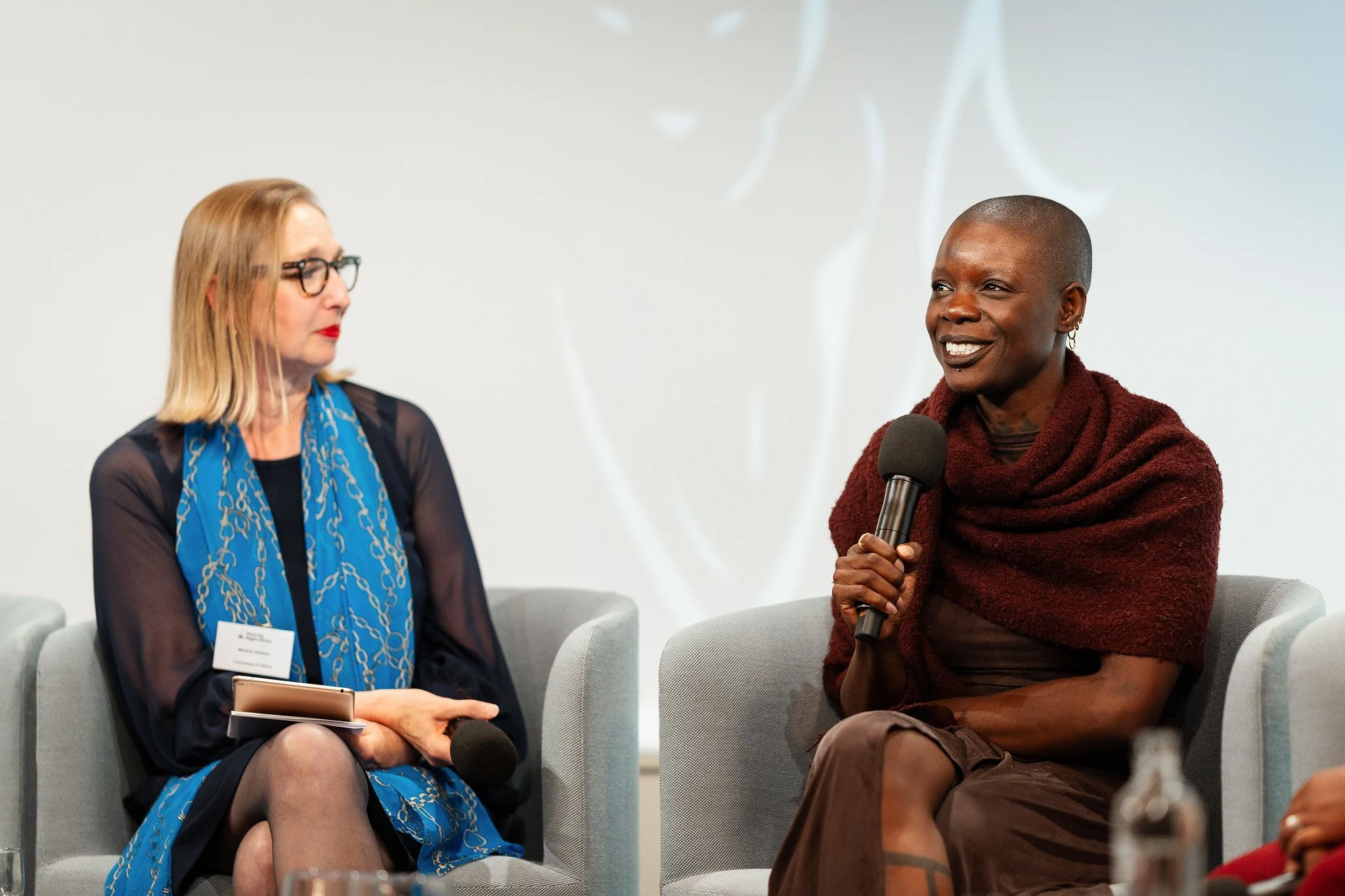
At the Lionesses of Africa Start-Up Night Africa 2025 in The Hague, the energy was unmistakable — a gathering of investors, development partners, and women entrepreneurs charting the continent’s future. On stage, Yvette Tetteh, co-founder of Ghana’s Pure & Just Co., and Hadija Jabiri, founder of Tanzania’s GBRI (Eat Fresh), shared how strategic investment and visionary execution are scaling their enterprises across borders. Moderated by Melanie Hawken, founder and CEO of Lionesses of Africa, the discussion, “Unlocking Value: The Business Case for Funding Africa’s Women Entrepreneurs in Growth Mode,” offered both inspiration and insight — showing investors what happens when capital meets capable leadership and women-led innovation.
From Seed Funding to Scalable Growth
When Yvette Tetteh first addressed Start-Up Night Africa in 2023, she was searching for capital to expand her dried-fruit processing company. Two years on, the transformation is striking.
“In the two years since, we’ve actually been able to secure the financing, move to a new factory… we increased our capacity ten x… we went from a team of 20 people to a team of 100 people.”
That leap wasn’t only about facilities — it was about systems and market readiness. Pure & Just Co. leveraged its financing to professionalize operations, strengthen supply chains, and meet export standards for new markets in Nigeria, the Netherlands, and Germany.
“What investment did was give us breathing room to think strategically,” said Yvette. “We were able to upgrade equipment, improve our cold-chain logistics, and negotiate better terms with distributors. It completely changed our competitiveness.”
Investors often ask how women-led businesses deploy capital differently. “We measure growth not just by volume but by value added at every stage — from farmer relationships to international quality compliance,” she explained.
GBRI’s Expansion: Turning Farmers into Global Suppliers
Across the continent in Tanzania, Hadija Jabiri has been leading a comparable transformation. From exporting fresh produce to Europe, her company GBRI (Eat Fresh) has evolved into a vertically integrated agribusiness with a state-of-the-art avocado oil factory.
“Our model proves that when women get the right capital, they multiply impact.”
“I was looking for $1 million, and I’m happy that we managed to get funding… we set up a factory… currently processing avocado oil that has made us impact 20,000 smallholder farmers in Tanzania, Burundi and now we are going to Rwanda.”
By processing locally, Hadija has moved up the value chain, capturing margins previously lost to importers.
“Investment allowed us to build real infrastructure — a processing plant, storage facilities, and a skilled technical team,” she said. “That combination means we can guarantee both volume and quality, which global buyers demand.”
Today, GBRI’s export footprint extends to India and, soon, China. Supported by 52 permanent employees and up to 200 daily workers, Hadija’s next ambition is to raise $6.5 million — $2.5 million in capital expenditure and working capital now, followed by $4 million for refining.
“Our model proves that when women get the right capital, they multiply impact,” Hadija added. “We’re not just exporting products — we’re exporting opportunity for thousands of farmers.”
Redefining the Financing Playbook
Both founders agreed that financing women-led enterprises is smart business, yet recognise that the financing landscape still needs recalibration.
“It’s the right time to design gender-responsive financial products… instead of asking for three years’ financials, look at mobile transaction history… many women don’t own collateral… come up with guarantee schemes so they can be financed.”
“Every woman founder I know reinvests profits into growth — not luxury,” Hadija said. “That reliability is what de-risks women-led enterprises. Funders who understand that will lead the next wave of returns.”
“If institutions can combine gender intelligence with financial innovation,” she added, “Africa will see an entirely new generation of scalable, investable women-led firms.”
The Value of Technical Assistance Done Right
Yvette echoed that funding alone is not enough; how capacity development support is delivered matters deeply.
“If I’ve been successful in fundraising the last few years, it’s because I’ve had an advisory firm that does a lot of one-on-one training… that just makes me so much more able to actually get the funding.”
“We measure growth not just by volume but by value added at every stage.”
Yvette advocates for targeted, ongoing financial mentorship. “Having an advisor review your projections weekly is game-changing,” she said. “It turns vague ambition into investable strategy. That level of rigour gives investors confidence.”
“We’re not just building a factory,” she added. “We’re building a model of sustainable food production that investors can replicate across Africa.”
Investor Takeaway: Partnering for Long-Term Value
The discussion, moderated by Melanie Hawken, highlighted a larger truth for investors: Africa’s women entrepreneurs are not just capital seekers — they are ecosystem builders. Their ventures generate employment, strengthen rural economies, and open new trade corridors.
“Look at what happens when you connect viable high-growth women-owned businesses,, and investors ready to listen,” Hawken told the audience.
What’s emerging is a more inclusive model of entrepreneurship financing, one that values mentorship, social impact, and measurable business performance equally.
Conclusion
For Africa’s investment community, the message from Start-Up Night Africa 2025 was unmistakable: funding women-led enterprises is not philanthropy — it’s performance investing. Entrepreneurs like Yvette Tetteh and Hadija Jabiri are demonstrating scalable, export-driven models that combine financial discipline with deep social impact. The call to action is for investors to structure capital that matches ambition, for banks to embed gender-responsive mechanisms, and for women founders to keep pushing for equity, access, and excellence. The continent’s next growth decade will belong to those who act on this opportunity now.